Poker guide
Positions & starting hands
Where you sit decides which hands you can play. Learn every seat at the table, the 169 starting hands, and which ones to raise from each position.
Updated:
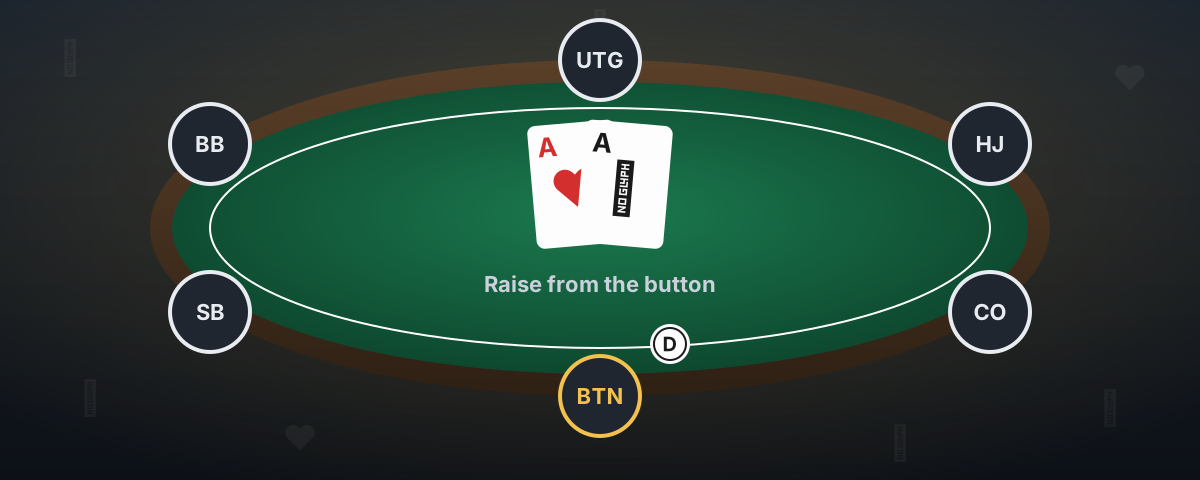
Two things decide most of your preflop decisions: where you sit relative to the dealer button, and which two cards you hold. The same hand can be a clear raise from the button and a clear fold from the first seat. This page explains every position at the table, how to read starting-hand notation, and which hands to open from each seat.
Why position matters
After the flop, the first player still in the hand to the left of the button acts first and the button acts last. Acting last is a big advantage, and it lasts for three betting rounds (flop, turn and river):
- You see what everyone else did first. A check from your opponent often shows weakness, and you decide with more information.
- You control the size of the pot. You can check behind to see a free card, or bet when they show weakness.
- Bluffs work better. It's much easier to win a pot when your opponent has already checked to you.
Being in position (IP) means you act after your opponent; out of position (OOP) means you act before them. Good players play more hands in late position and fewer in early position, because the late seats get to play the hand in position more often.
The positions at a full table
Before the flop, the action starts with the player to the left of the big blind and moves clockwise; the big blind acts last. From the flop onwards, the small blind acts first (if still in the hand) and the button acts last.
| Position | What it means for you |
|---|---|
| UTG Under the gun | First to act preflop, with up to eight players still to act behind you. Play your tightest range here. |
| UTG+1 Under the gun +1 | Almost as hard as UTG. Only a little wider. |
| MP Middle position | Also called UTG+2. Still many players behind you: play strong hands and good suited hands. |
| LJ Lojack | Three seats to the right of the button. Ranges start to open up. |
| HJ Hijack | Two seats to the right of the button. A good spot to start stealing the blinds. |
| CO Cutoff | One seat to the right of the button, the second-best seat. Open a wide range. |
| BTN Button (dealer) | The best seat at the table: you act last on every street after the flop. Open the widest range. |
| SB Small blind | Half a bet already in, but you'll be out of position after the flop in every hand. The hardest seat to win money from. |
| BB Big blind | A full bet already in and last to act preflop, so you get a discount to call. Defend widely, but you'll play out of position. |
Six-max and heads-up
Online and in many live games, tables have six seats ("6-max"). The early seats are removed and the rest keep their names: UTG, HJ, CO, BTN, SB, BB (some sites call the 6-max UTG seat "LJ"). In heads-up (two players), the button is also the small blind: it acts first before the flop and last on every later street, which is why it raises the most hands.
| Players | Positions, in order of preflop action |
|---|---|
| 9 | UTG · UTG+1 · MP · LJ · HJ · CO · BTN · SB · BB |
| 8 | UTG · UTG+1 · LJ · HJ · CO · BTN · SB · BB |
| 6 | UTG · HJ · CO · BTN · SB · BB |
| 2 | BTN / SB · BB |
Reading starting hands
There are 1,326 possible two-card hands, but many play the same way, so they are grouped into 169 starting hands:
Pocket pairs
Written AA, 77, 22. For example 7♠7♥.
Suited (s)
Both cards of the same suit. AKs = A♥K♥, A♠K♠ … Suited hands can make flushes.
Offsuit (o)
Different suits. AKo = A♥K♣, A♦K♠ … Three times as many combos as suited.
Range shorthand you'll see in charts and books:
- 77+ means 77, 88, 99 … up to AA.
- ATs+ means ATs, AJs, AQs and AKs (the top card stays, the kicker goes up).
- K9s–K6s means K9s, K8s, K7s and K6s.
- Suited connectors are hands like 87s and 65s; one-gappers skip a rank, like 97s; broadway cards are T, J, Q, K and A.
How much does suited add? Only about 2–4% in equity. A♥K♥ beats A♦K♣ by a small margin, so don't play a weak hand just because it's suited.
Starting hand groups
AA, KK, QQ, AKs, AKo
Raise from any seat and re-raise (3-bet) when someone has already raised. These win the biggest pots.
JJ, TT, AQs, AQo, AJs, KQs
Raise from any seat. Against a raise from an early-position player, calling is often better than re-raising.
99–22, A5s–A2s, suited connectors
Small pairs want to hit a set; suited aces and connectors make straights and flushes. They prefer deep stacks, position and cheap flops.
KJo, QJo, ATo, KTo
They look good but are often dominated: when AK or AQ is out, you win small pots and lose big ones. Fold them from early seats.
Opening ranges by position (Average)
This chart shows an average raise-first-in range (you're the first player to put chips in) for a 6-max cash game. Pick a stack depth (50, 100 or 300 big blinds) and a seat to see which hands to play and what to do with them. The BB never opens (if everyone folds, you win the blinds), so its tab shows an average defending range against a single raise. Tap any hand for its combos and action.
- Yellow: your strongest hands. Raise, and if someone re-raises (3-bets), re-raise again: a 4-bet at 100–300 bb, all-in at 50 bb. From the BB, yellow means 3-bet.
- Green: raise. If someone 3-bets, call with the better hands that play well after the flop and fold the rest.
- Blue (BB only): call the raise.
- Grey: fold.
Why stack depth matters: with 50 bb there's less money left to win after the flop, so small pairs and suited connectors lose value and high cards like ATo and KJo gain it. With 300 bb it's the opposite: hands that can make sets, straights and flushes win huge pots, while offsuit hands that make second-best pairs (KJo, ATo) lose big ones, and you only put all your chips in before the flop with AA or KK.
About these ranges: they are a simplified starting point, close to what solvers suggest and rounded so they're easy to remember. Against very tight or very loose players, and in tournaments with antes, the best ranges change.
When someone has already raised
If a player has raised before you, play much tighter and choose between three actions:
- 3-bet (re-raise) with your premium hands for value, plus a few hands that block your opponent's best hands, like A5s and A4s.
- Call with hands that play well after the flop, like pocket pairs and suited broadways, mostly when you'll be in position.
- Fold everything else. The earlier the raise, the stronger the raiser's range, so tighten up against an UTG raise.
From the big blind, you already have a full bet in and close the action, so you get a good price: defend much wider against a small raise from the button than against a raise from early position.
Common mistakes
- Playing too many hands from early position. KJo looks pretty, but UTG it's a fold in most games.
- Limping. Just calling the big blind when nobody has raised gives up the chance to win the pot right away. Raise or fold instead.
- Calling too much from the small blind. You'll be out of position for the whole hand. Raise or fold most of the time.
- Overvaluing any ace. A9o and A8o lose a lot against better aces. Small suited aces are much more playable.
- Not stealing enough from the button. When everyone folds to you on the button or cutoff, raising a wide range is how winning players collect the blinds.
Practise it: heads-up is the best training for position, because you're on the button every other hand. Try a match in Heads Up with Legends, then check your all-in spots with the Pre-flop All-in calculator.
Frequently asked questions
What is the best position in poker?
The button (BTN). It acts last on the flop, turn and river, so the player there always sees what everyone else does before deciding.
What does UTG mean in poker?
UTG stands for "under the gun": the seat directly to the left of the big blind. It acts first before the flop, so it should play the tightest range.
What are the cutoff, hijack and lojack?
They are the seats one, two and three places to the right of the button. The cutoff (CO) is the second-best seat; the hijack (HJ) and lojack (LJ) are middle positions.
How many starting hands are there in Texas Hold'em?
There are 1,326 two-card combinations, which group into 169 distinct starting hands: 13 pocket pairs, 78 suited hands and 78 offsuit hands.
What percentage of hands should I play from the button?
In a 6-max cash game with 100 big-blind stacks, a good raise-first-in range from the button is roughly 40–45% of hands. From under the gun it is closer to 15–18%.
Is the small blind or the big blind the worse seat?
Both blinds lose chips over time because they post forced bets and play out of position. The small blind is harder: it acts first after the flop and gets a worse price to call than the big blind.