Poker guide
Poker 101
Everything you need to sit down at a Texas Hold'em table: what beats what, who acts when, and how a hand plays out from the deal to the showdown.
Updated:
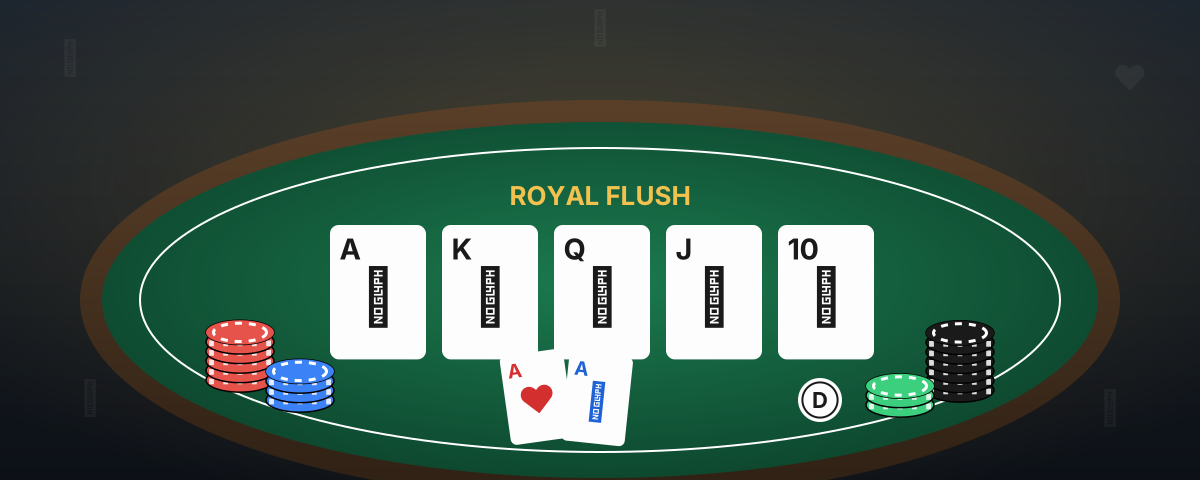
Texas Hold'em is the world's most popular poker game, and everything on this page is about it — though most of the ideas (blinds, betting rounds, showdown) carry over to other games too. The goal is simple: win chips, either by having the best five-card hand at the end, or by betting so that everyone else folds.
The cards you get
Hold'em uses one standard 52-card deck. Each hand:
- Every player gets two private cards ("hole cards"), face down — for example A♠K♥.
- Up to five shared cards (the "board") are dealt face up in the middle, for everyone to use.
- Your hand is the best five cards out of your two plus the five on the board. You can use both, one, or even none of your own cards.
Hand rankings
From strongest to weakest. Suits are all equal — a spade flush is no better than a heart flush.
| # | Hand | Example | What it is |
|---|---|---|---|
| 1 | Royal flush | A♥K♥Q♥J♥10♥ | A-K-Q-J-10, all one suit |
| 2 | Straight flush | 9♠8♠7♠6♠5♠ | Five in a row, all one suit |
| 3 | Four of a kind | Q♠Q♥Q♦Q♣7♠ | Four cards of one rank |
| 4 | Full house | J♠J♥J♦4♣4♠ | Three of a kind plus a pair |
| 5 | Flush | A♦J♦8♦6♦2♦ | Any five of one suit |
| 6 | Straight | 10♣9♦8♥7♠6♣ | Five in a row, mixed suits |
| 7 | Three of a kind | 7♠7♥7♣K♦2♠ | Three cards of one rank |
| 8 | Two pair | K♠K♦5♥5♣9♠ | Two different pairs |
| 9 | One pair | 10♥10♣A♦8♠3♥ | Two cards of one rank |
| 10 | High card | A♦Q♠9♥6♣3♦ | None of the above |
Ties and kickers
- When two players have the same kind of hand, the higher cards win: a pair of Kings beats a pair of Queens.
- If the main part is equal, the remaining cards — the kickers — decide it. K♠K♦ with an Ace beats K♥K♣ with a Queen.
- Only five cards count. If both players' best five cards are identical, they split the pot.
- The Ace is high, but can also be low in a straight: 5♥4♣3♦2♠A♥ (the "wheel") is the lowest straight.
The button, blinds and antes
A round disc called the dealer button marks who acts last after the flop. It moves one seat to the left after every hand, so everyone takes turns being in the best position.
- Small blind (SB): the player to the left of the button puts in a forced bet, usually half the big blind.
- Big blind (BB): the next player puts in the full forced bet. Blinds make sure there's always something to play for. Stakes are named after them: a "1/2 game" has a $1 small blind and $2 big blind.
- Antes: in some games (most tournaments, later on), everyone also puts in a small amount before the cards are dealt. Often just the big blind pays it for the table, as a "big blind ante".
Heads-up (two players): the button posts the small blind and acts first before the flop, then last on every later street. This is how our Heads Up with Legends game works.
Your options when it's your turn
Check
Pass the action without putting in chips. Only allowed when nobody has bet on this street.
Bet
Put chips in. Others must now call, raise or fold. The minimum bet is normally one big blind.
Call
Match the current bet to stay in the hand.
Raise
Increase the bet. In no-limit, a raise must be at least as big as the previous bet or raise on that street.
Fold
Give up your hand and any chips you've already put in. You're out until the next hand.
All-in
Bet all your chips. You can never lose more than you have on the table, and you can still win the part of the pot you've matched.
Tip: say your action out loud in a live game ("raise to 60") before moving chips. Putting chips in bit by bit without saying anything (a "string bet") may only count as a call.
The four betting rounds
- Preflop. Everyone gets two hole cards. Betting starts with the player to the left of the big blind ("under the gun") and goes clockwise. The big blind acts last and may check if nobody raised.
- The flop. One card is "burned" (discarded face down), then three board cards are dealt face up. From now on, betting starts with the first player still in the hand to the left of the button.
- The turn. Burn one, deal a fourth board card. Another round of betting.
- The river. Burn one, deal the fifth and final board card. The last round of betting.
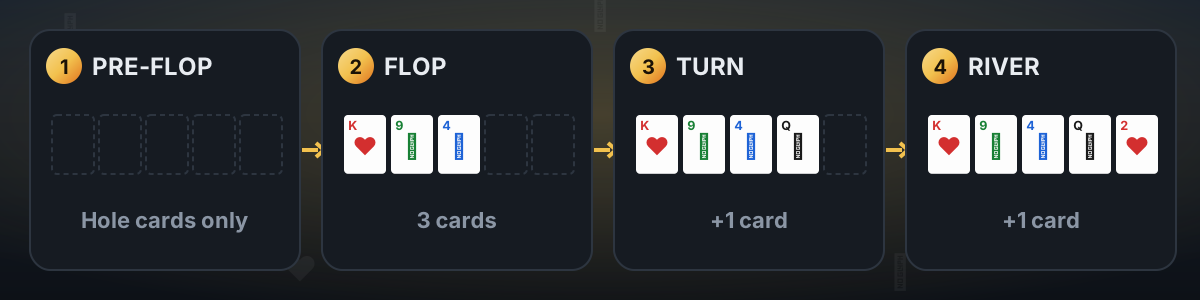
A betting round ends when everyone still in the hand has put in the same amount (or is all-in) and has had a chance to act. If everyone but one player folds at any point, that player wins the pot straight away — no cards shown.
Order of action
| Street | Acts first | Acts last |
|---|---|---|
| Preflop | Left of the big blind ("under the gun") | Big blind |
| Flop, turn, river | First active player left of the button | The button (or nearest player still in, to its right) |
| Heads-up preflop | Button / small blind | Big blind |
| Heads-up after the flop | Big blind | Button |
Acting last is a big advantage — you see what everyone else does before you decide. That's why the button is the best seat and the blinds are the hardest to play from.
Showdown
If two or more players are still in after the river betting, they show their cards and the best hand wins.
- Who shows first: the last player to bet or raise on the river. If the river was checked through, the first player to the left of the button shows first.
- Mucking: once a better hand is shown, a losing player may throw their cards away face down instead of showing.
- Cards speak: the best hand wins even if its owner misreads it — the dealer reads the cards, not what players say.
- Playing the board: if the best five cards are all on the board, everyone still in splits the pot.
All-ins and side pots
You can only win from each opponent what you put in yourself. If you're all-in for 100 and two other players keep betting to 300 each, the first 100 from everyone forms the main pot (which you can win), and the extra chips form a side pot only those two players can win. Each pot is awarded separately at showdown.
No-limit, pot-limit and fixed-limit
| Structure | Biggest bet allowed | Commonly used for |
|---|---|---|
| No-limit (NL) | All your chips, any time | Hold'em |
| Pot-limit (PL) | The size of the pot (including your call) | Omaha — see More than Hold'em |
| Fixed-limit (FL) | Set amounts: a small bet on early streets, a big bet (2×) on the turn and river, usually capped at a few raises | Stud, mixed games |
Words you'll hear at the table
| Outs | Cards still in the deck that would improve your hand into the winner. Try them out on our Outs Counting page. |
| Pot odds | The price of a call compared to the pot. Calling 10 to win a pot of 30 means you need to win at least 1 time in 4 (25%). |
| The nuts | The best possible hand on that board. |
| Position | Where you act in the order. "In position" = acting after your opponent. |
| Draw | A hand that needs another card, e.g. four to a flush. |
| Bluff | Betting with a weak hand to make a better hand fold. |
| Stack | The chips in front of you. Often counted in big blinds ("100 bb deep"). |
| Muck | Folded cards, or folding without showing. |
Frequently asked questions
What beats what in Texas Hold'em?
From best to worst: royal flush, straight flush, four of a kind, full house, flush, straight, three of a kind, two pair, one pair, high card.
Does a flush beat a straight?
Yes. A flush (five cards of the same suit) beats a straight (five cards in a row). A full house beats both.
How many cards do you get in Texas Hold'em?
Two private cards (hole cards). Five shared cards are dealt face up in the middle, and you make your best five-card hand from any of those seven cards.
What are the blinds in poker?
Forced bets posted by the two players to the left of the dealer button before the cards are dealt: the small blind and the big blind (usually twice the small blind). They make sure there is always something to win.
What happens if two players have the same hand?
The pot is split equally between them. Suits never break a tie in Texas Hold'em.
What is a side pot?
When a player is all-in and others keep betting, the extra chips go into a side pot. The all-in player can only win the main pot, the part they could match.